
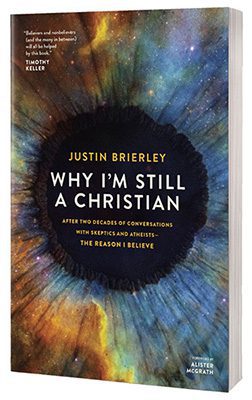
Why I’m Still a Christian by Justin Brierley
Justin Brierley, in his book Why I’m Still a Christian, unpacks his reasons for remaining a Christian after two decades of hosting conversations with skeptics of the Christian faith. Brierley avoids the pitfalls of strawmanning skeptical arguments, and instead engages with the most robust form of their arguments. Along the way, he presents his own reasons for holding on to his Christian faith.
Brierley begins his book by giving his background as a radio host of a show called Unbelievable?, a show where he moderated Christians and skeptics as they discussed topics surrounding whether God exists, the validity of the Bible, and how science and Christianity may or may not contradict. Unlike some books that build arguments through fact heavy methods, Brierley builds a case that the existence of God makes sense of human existence, value, and purpose.
Working through scientific, moral, and teleological evidence, he makes a convincing argument for God’s existence. Next, he examines the evidence for the truth of Christianity by investigating the claims of Jesus of Nazareth, and his death and resurrection. By evaluating the historical evidence for Christianity, Brierley continues to build his case for why he still remains a Christian.
For the last few chapters of his book, Brierley engages the critics of atheism to Christianity and the existence of God, particularly in regards to the problem of suffering. One argument of his that I particularly appreciated addressed the rise and fall of the New Atheism movement of the late 90s and early 2000s. (I unpack my thoughts on this particular chapter more in my post “New Atheism: More Emotional than Academic?”) In it he draws out this very important argument against God: the problem of evil and suffering. I would agree with Brierley that this is an argument that Christians must deal with, but also one that cannot be answered solely by academic and logical means.
We are relational and experiential beings. Suffering and evil affects us emotionally as well as physically. A logical argument is not going to satisfy an emotional question. Only an answer that honestly acknowledges the emotional pain behind the question can even begin to navigate those arguments. At the end of the day, I do believe Christians have the only response for those struggling with the emotional question of evil and suffering. However, the answer is one they must choose to accept. They must determine if the answer and argument satisfies their own personal questions. No amount of arguing or debate will otherwise persuade them.
And this is how Brierley ends his book: drawing in the story of the Bible. He presents the gospel story in a way that his readers can choose to accept it or not. The evidence for the truth of Christianity exists, but it is a personal choice, a step of faith. The story of the gospel introduces us to the man Jesus of Nazareth, his incredible claim to be God, and his death and resurrection. The gospel is not just the story of a great teacher or miracle worker, but of a man who claimed to be God, and then backed up this claim by rising from the dead. The evidence for the truth of this story exists, but it is still a personal step that every individual must make to believe the evidence and story for themselves.